Microplastics are creeping into our bodies. How much exposure can we withstand?
From fish and crops to toothpaste and cosmetics, microplastics are entering our food chain, raising questions about the health risks of a pollutant we cannot see
- ADAB
- August 16, 2026
- 3:46 pm
- No Comments
Silent Invasion, Stealth Exposure
Widespread contamination: Microplastics permeate Bangladesh’s waterways, sea life, and daily cosmetics, entering our food chain
Alarm in animal models: Studies show ingested microplastics cause liver, kidney, and blood-cell damage in test mammals
Threat of bioaccumulation: Unchecked exposure risks exceeding toxic thresholds as particles degrade into bloodstream-bound nanos
Call for urgent governance: Experts demand swift plastic waste management, eco-restoration, and dedicated local research
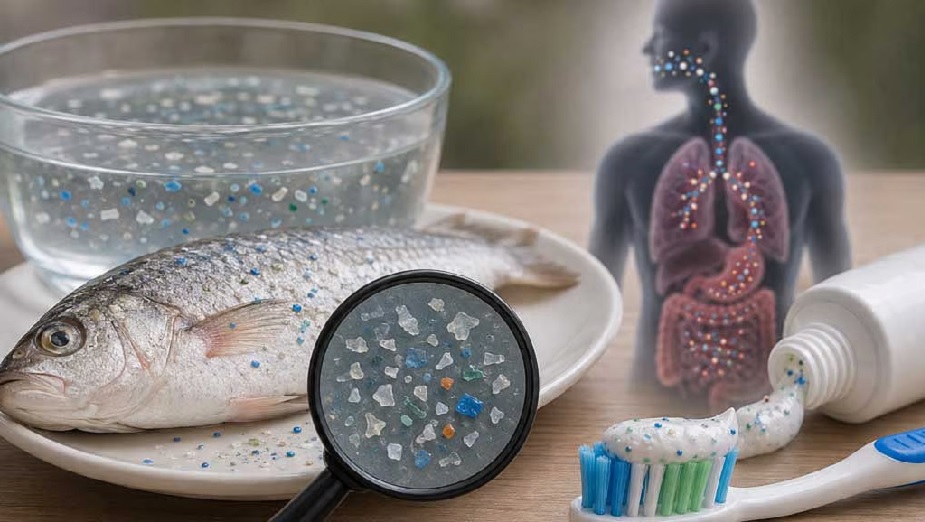
The plastic we throw away does not simply disappear. It breaks down, fragments and, eventually, becomes small enough to enter places we rarely think to look -- the fish on our dinner table, the water we drink, even products we use every day.
These particles, known as microplastics, are turning up across Bangladesh’s environment and food chain. What happens after they enter the human body, however, remains a question scientists are still trying to answer.
Researchers say there is no conclusive evidence that every microplastic particle entering the body causes immediate harm. But as exposure mounts, laboratory studies are offering increasingly troubling clues about what prolonged accumulation could mean for human health.
The Environment and Social Development Organization (ESDO) recently reported finding microplastics in 26 of 34 toothpaste brands sold in Bangladesh.
Meanwhile, a three-year study by researchers at Bangladesh Agricultural University found microplastics in 13 species of fish collected from the sea, rivers and wetlands.
Together, the findings point to a troubling reality: microplastics are already moving through the food chain that sustains us.
Widespread contamination: Microplastics permeate Bangladesh’s waterways, sea life, and daily cosmetics, entering our food chain
Alarm in animal models: Studies show ingested microplastics cause liver, kidney, and blood-cell damage in test mammals
Threat of bioaccumulation: Unchecked exposure risks exceeding toxic thresholds as particles degrade into bloodstream-bound nanos
Call for urgent governance: Experts demand swift plastic waste management, eco-restoration, and dedicated local research
The plastic we throw away does not simply disappear. It breaks down, fragments and, eventually, becomes small enough to enter places we rarely think to look -- the fish on our dinner table, the water we drink, even products we use every day.
These particles, known as microplastics, are turning up across Bangladesh’s environment and food chain. What happens after they enter the human body, however, remains a question scientists are still trying to answer.
Researchers say there is no conclusive evidence that every microplastic particle entering the body causes immediate harm. But as exposure mounts, laboratory studies are offering increasingly troubling clues about what prolonged accumulation could mean for human health.
The Environment and Social Development Organization (ESDO) recently reported finding microplastics in 26 of 34 toothpaste brands sold in Bangladesh.
Meanwhile, a three-year study by researchers at Bangladesh Agricultural University found microplastics in 13 species of fish collected from the sea, rivers and wetlands.
Together, the findings point to a troubling reality: microplastics are already moving through the food chain that sustains us.
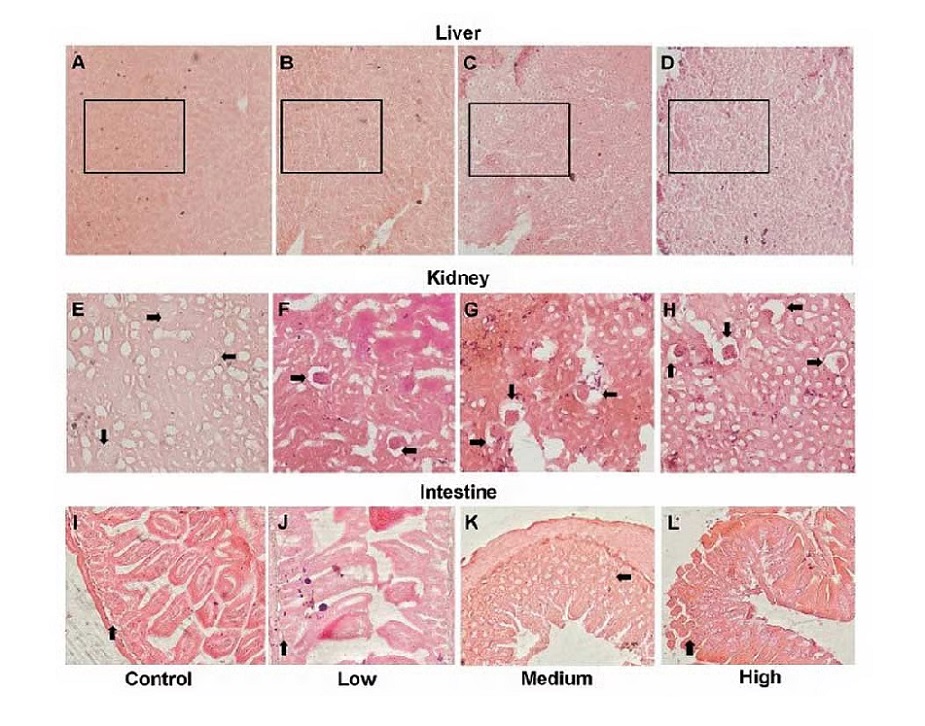
Excessive microplastic exposure causes changes in cells in the liver, kidneys and intestines of monkeys.
What Happens Once It Gets Inside?
Microplastics are plastic particles measuring 5mm or less, often too small to see with the naked eye.
A Bangladeshi research team recently published findings from a two-year study examining their effects on mammals. The study, involving four researchers including Dhaka University zoology Prof Mohammad Firoz Zaman, appeared in the journal “Emerging Contaminants”.
“We took mammals, rats, as the model animals to test what effects microplastics could have on the human body. This means that the harm seen in rats could occur in the human body in a similar way,” Firoz told bdnews24.com.
The researchers fed rats PVC microplastics, about 125 micrometres (μm) in size, mixed into their food at concentrations of 5 percent, 10 percent and 15 percent for 13 weeks.
Higher concentrations affected the animals’ growth, blood-cell formation and markers of oxidative stress. Changes were also found in tissues of the liver, intestines and kidneys, although microplastics were detected accumulating only in intestinal tissue.
Rats exposed to higher concentrations showed significantly reduced growth, while their liver weight increased relative to body weight. Their red blood cells also showed abnormal shapes, although the overall blood-cell count did not change significantly.
Microplastics are plastic particles measuring 5mm or less, often too small to see with the naked eye.
A Bangladeshi research team recently published findings from a two-year study examining their effects on mammals. The study, involving four researchers including Dhaka University zoology Prof Mohammad Firoz Zaman, appeared in the journal “Emerging Contaminants”.
“We took mammals, rats, as the model animals to test what effects microplastics could have on the human body. This means that the harm seen in rats could occur in the human body in a similar way,” Firoz told bdnews24.com.
The researchers fed rats PVC microplastics, about 125 micrometres (μm) in size, mixed into their food at concentrations of 5 percent, 10 percent and 15 percent for 13 weeks.
Higher concentrations affected the animals’ growth, blood-cell formation and markers of oxidative stress. Changes were also found in tissues of the liver, intestines and kidneys, although microplastics were detected accumulating only in intestinal tissue.
Rats exposed to higher concentrations showed significantly reduced growth, while their liver weight increased relative to body weight. Their red blood cells also showed abnormal shapes, although the overall blood-cell count did not change significantly.
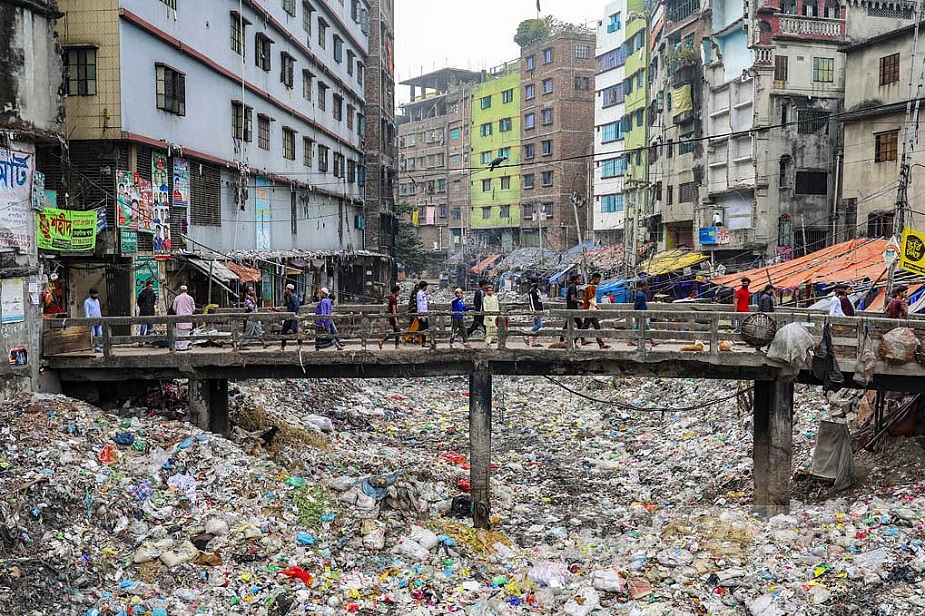
A stretch of Keraniganj’s Shubhadhya Canal lies buried beneath plastic waste, with people crossing the culvert above.
“There are many kinds of harm. It shortens lifespan; it damages the kidneys, damages the liver, damages cells. There are six to seven effects,” Zaman said.
“We worked for two years. We prepared feed containing microplastics and fed it to them. Then we observed the effects -- what happens to cells, what happens to the kidneys, how it affects blood-cell development.”
The researchers caution that animal findings cannot simply be treated as proof of identical effects in humans. But they offer a warning about what prolonged exposure might do.
From Rivers and Fish to Dinner Tables
Prof Md Shahjahan of Bangladesh Agricultural University led research conducted in 2023, 2024 and 2025 into microplastic contamination in fish.
His team found the particles in fish from the sea, the Brahmaputra, Chalan Beel and Arial Beel. The affected species included koi, bata, meni, gulsha tengra and punti, as well as Bombay duck, ribbon fish and phaisa.
Microplastics were found in fish intestines, gills and flesh. Most were fibres measuring between 101 and 300μm.
“There is no globally established standard for microplastics yet,” Shahjahan said, noting that unlike other toxic substances, there is no internationally agreed safe limit.
He warned that the problem could worsen as larger plastic fragments break down into nanoplastics, which may enter the bloodstream or become deposited in muscles.
“If this continues, by 2050 we may see as much microplastic in the sea as there are fish,” he said.
The scale of plastic pollution is visible in the waterways themselves. During construction of the Karnaphuli Tunnel, Shahjahan said, layers of polythene roughly 2 to 3ft deep were found on the riverbed.
“This polythene breaks down and becomes microplastics. We use brushes, toothpaste and cosmetics -- these also contain microplastics. These are going into the environment.”
A Pollutant Hard to Escape
Microplastics can reach people through contaminated fish and crops, Zaman said.
“Microplastics become contaminated with food in the ecosystem and enter the human body through fish. They can also enter crops through irrigation water, and from there reach the vegetables and other food we eat.”
Yet scientists still cannot say precisely how much exposure is dangerous.
“We worked for two years. We prepared feed containing microplastics and fed it to them. Then we observed the effects -- what happens to cells, what happens to the kidneys, how it affects blood-cell development.”
The researchers caution that animal findings cannot simply be treated as proof of identical effects in humans. But they offer a warning about what prolonged exposure might do.
From Rivers and Fish to Dinner Tables
Prof Md Shahjahan of Bangladesh Agricultural University led research conducted in 2023, 2024 and 2025 into microplastic contamination in fish.
His team found the particles in fish from the sea, the Brahmaputra, Chalan Beel and Arial Beel. The affected species included koi, bata, meni, gulsha tengra and punti, as well as Bombay duck, ribbon fish and phaisa.
Microplastics were found in fish intestines, gills and flesh. Most were fibres measuring between 101 and 300μm.
“There is no globally established standard for microplastics yet,” Shahjahan said, noting that unlike other toxic substances, there is no internationally agreed safe limit.
He warned that the problem could worsen as larger plastic fragments break down into nanoplastics, which may enter the bloodstream or become deposited in muscles.
“If this continues, by 2050 we may see as much microplastic in the sea as there are fish,” he said.
The scale of plastic pollution is visible in the waterways themselves. During construction of the Karnaphuli Tunnel, Shahjahan said, layers of polythene roughly 2 to 3ft deep were found on the riverbed.
“This polythene breaks down and becomes microplastics. We use brushes, toothpaste and cosmetics -- these also contain microplastics. These are going into the environment.”
A Pollutant Hard to Escape
Microplastics can reach people through contaminated fish and crops, Zaman said.
“Microplastics become contaminated with food in the ecosystem and enter the human body through fish. They can also enter crops through irrigation water, and from there reach the vegetables and other food we eat.”
Yet scientists still cannot say precisely how much exposure is dangerous.
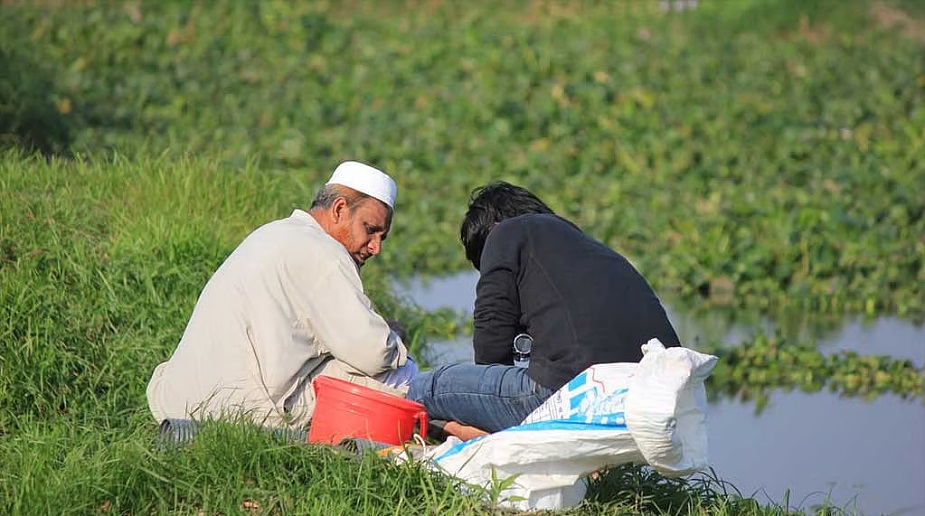
Prof Shahjahan collects samples for research (left). File photo
“Just because microplastics enter the human body does not mean they will cause harm. They have to enter in sufficient quantities. What amount causes harm and what amount does not, we have shown in our research,” Zaman said.
“If they keep entering our bodies continuously, at some point the level will exceed the threshold. And once it exceeds that level, the body will inevitably be harmed.”
His advice is blunt: “We have to reduce the use of microplastics. And if reducing their use is difficult, then people must not throw plastic into the environment. It must be disposed of in designated places.”
“Plastic use must be stopped. And if we cannot stop using it, it must be managed scientifically, as other countries are doing.”
The Search for Answers
Public health and epidemiology expert Dr Mushtuq Husain believes Bangladesh’s uncontrolled plastic consumption warrants urgent investigation.
“Our use of plastic here is completely uncontrolled. So our concern is that microplastics are present at dangerous levels,” he said.
He called for research into how microplastics can be removed from food, water and medicines.
“We need to conduct research on this -- how it can be reduced. We need to find scientific methods for separating it and removing it from the food chain, water supply and medicines. We cannot simply look to research from abroad; we have to conduct our own research too.”
He also urged stronger enforcement of existing measures, including restrictions on single-use polythene and plastic bottles.
“If they keep entering our bodies continuously, at some point the level will exceed the threshold. And once it exceeds that level, the body will inevitably be harmed.”
His advice is blunt: “We have to reduce the use of microplastics. And if reducing their use is difficult, then people must not throw plastic into the environment. It must be disposed of in designated places.”
“Plastic use must be stopped. And if we cannot stop using it, it must be managed scientifically, as other countries are doing.”
The Search for Answers
Public health and epidemiology expert Dr Mushtuq Husain believes Bangladesh’s uncontrolled plastic consumption warrants urgent investigation.
“Our use of plastic here is completely uncontrolled. So our concern is that microplastics are present at dangerous levels,” he said.
He called for research into how microplastics can be removed from food, water and medicines.
“We need to conduct research on this -- how it can be reduced. We need to find scientific methods for separating it and removing it from the food chain, water supply and medicines. We cannot simply look to research from abroad; we have to conduct our own research too.”
He also urged stronger enforcement of existing measures, including restrictions on single-use polythene and plastic bottles.
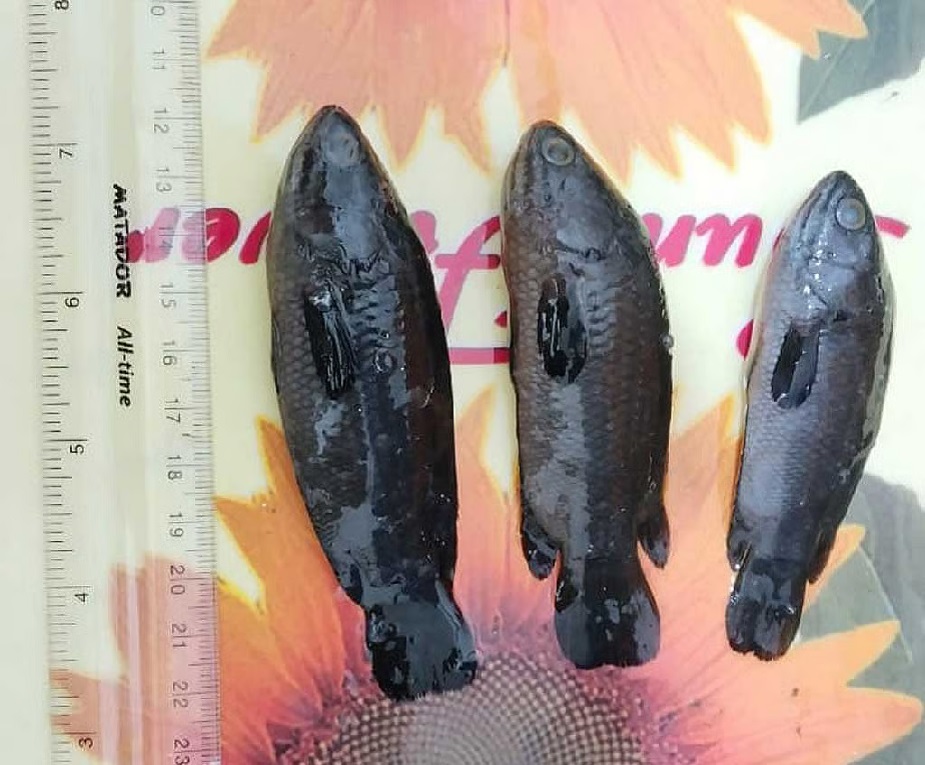
Koi fish collected for testing for the presence of microplastics.
Bangladesh produces vast quantities of plastic waste, much of which is either recycled, buried or released into the environment. Researchers say water contamination also varies by season, peaking during the monsoon as rain washes plastic waste into wetlands and waterways.
For the government, however, the science is still catching up with the scale of the problem.
“It is now a global problem; it is not just a problem for Bangladesh. So we are trying to learn more about it. I do not want to comment on the existing problem without knowing the full picture,” Fisheries and Livestock Minister Mohammad Amin Ur Rashid said.
“We have to try to get out of this problem. Alongside more research on plastic pollution, many ministries are involved and there are issues of implementation. The right approach is to coordinate our thinking and work from our respective positions.”
For now, the plastic remains -- breaking down into particles too small to see, but increasingly difficult to keep out of the world around us.
For the government, however, the science is still catching up with the scale of the problem.
“It is now a global problem; it is not just a problem for Bangladesh. So we are trying to learn more about it. I do not want to comment on the existing problem without knowing the full picture,” Fisheries and Livestock Minister Mohammad Amin Ur Rashid said.
“We have to try to get out of this problem. Alongside more research on plastic pollution, many ministries are involved and there are issues of implementation. The right approach is to coordinate our thinking and work from our respective positions.”
For now, the plastic remains -- breaking down into particles too small to see, but increasingly difficult to keep out of the world around us.
– Sources: Moinul Hoque Chowdhury - bdnews24.com